Anna Tarakanova, Assistant Professor in Mechanical Engineering and Biomedical Engineering at UConn, studies ways that the structural features of complex networks like extracellular matrices (ECM) support their function. To explore this further, she decided to find a way to recreate her ECM micro-structure data into enlarged physical models that are visible to the naked eye.
She approached Joe Luciani, Director of the Proof of Concept Center (POCC), an experienced innovator at Tech Park. His extensive collaborative experience with faculty, students and companies of all sizes paired with his expertise utilizing POCC’s state-of-the-art prototyping and fabrication equipment was well aligned with Anna’s research goals.
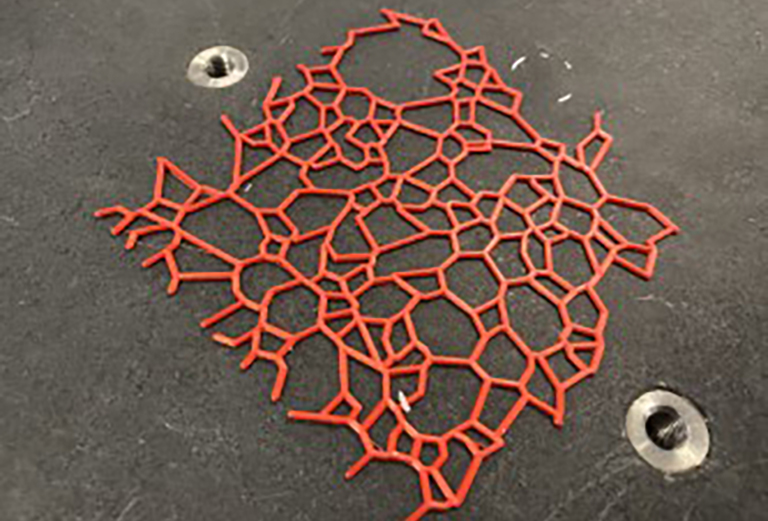
To kick off the project, Anna provided her structural data set as a shareable source. Joe converted the file using 3D modeling software, Rhinoceros3D, with a visual programming plugin, Grasshopper3D, that crunched the data to produce a network of nodes and linkages – i.e., a 3D model. Joe used this 3D model to successfully print larger-than-life ECM samples in POCC’s Stratasys 3D printers. He also recorded the printing process by programming one of the center’s robots to hold a camera and move through a few waypoints.
Anna provides some additional insight into her research. She explains, “Our research is focused on understanding the structure-function connectivity of complex heterogeneous systems like extracellular matrix (ECM) networks [the printed specimen] by establishing a microstructure-resolved deep learning framework that couples imaging data of matrix microstructure with multiscale computational modeling from the nanoscale, 3D printed prototyping, and in vitro mechanical testing of tissue specimens.”
The project is a new collaboration between Professor Tarakanova, Hongyi Xu, Assistant Professor in Mechanical Engineering at UConn, and David M. Pierce, Associate Professor in Mechanical Engineering and Biomedical Engineering at UConn.
“This is an exciting new line of convergent research that utilizes heterogeneous 2D experimental microscopic imaging data to stochastically reconstruct realistic 3D matrix structures through a statistically-driven, generative deep learning approach for a representative model system: healthy and osteoarthritic articular cartilage, ” says Pierce.